

















The Polyurethane Edge on a Drum Cleaning Blade: Angle, Hardness and Service Life
The Polyurethane Edge on a Drum Cleaning Blade: Angle, Hardness and Service Life
 2026-12-11
 6


A drum cleaning blade is a strip of polyurethane two to three millimetres thick, loaded against a rotating drum, and it is the part that decides whether a page leaves the machine clean or carries a grey film across every print. Whether the same blade lasts a million revolutions or gives up in ten thousand comes down to three parameters working together: the angle at which its edge meets the drum, the hardness of the polymer behind that edge, and the service life that follows from the two. Change one, and the other two stop behaving as designed.
That interdependence is why fitting a cheaper blade so often makes things worse rather than better. A cleaning blade is not a wear strip that any flexible plastic can imitate — it is a tuned mechanical system, and the sheet in the output tray is its report card.
What the Blade Actually Does
Toner transferred onto the paper does not leave the drum perfectly clean. A residue stays on the surface after every revolution — only a few per cent of the original image, but enough to print a faint second copy of the previous page if a blade never touched it.
The cleaning blade sits as a wiper against the drum and scrapes that residue off into a waste chamber. It runs in permanent contact, at a pressure low enough not to wear the photoconductor coating yet high enough to shear the toner film away. Both conditions must hold at once, on every rotation, for the life of the part.
That is the whole job. The angle, the hardness and the coating all exist for one purpose: keeping those two conditions true.
The Edge Angle: How the Blade Meets the Drum
The edge angle is the geometry of how the blade tip contacts the drum surface, and it decides whether the blade scrapes or merely skims.
Set the edge too flat and the contact pressure collapses. The blade rides across the toner film instead of cutting under it, leaving a thin residue that returns as background haze and ghosting. Set it too steep and the opposite happens: pressure spikes at the tip, the polyurethane deforms under the load, and the blade starts acting like a chisel — wearing faster, dragging more torque out of the drum drive, and in the worst case turning over completely.
A turned edge, where the blade folds backwards under its own load, is the failure technicians recognise as a sudden and total loss of cleaning rather than a gradual one. Once the edge has flipped it does not recover; cleaning stops outright, and the next casualty is usually the drum itself, scored by the deformed edge pressing against it.
Hardness: What the Polymer Has to Balance
Behind the edge, hardness determines how the blade behaves under the load the angle imposes.
A blade that is too soft cannot hold its edge. Under continuous pressure it deforms and rolls, losing the sharp line that does the scraping, and it may chatter — leaving periodic marks along the drum instead of a clean pass. A blade that is too hard loses conformability. It stops following the drum surface and its own tolerance stack, concentrates load on a few high spots, and begins to scratch the photoconductor, a far more expensive part than the blade that damaged it.
There is also a time dimension. Polyurethane that is correct on day one can harden with age and heat, turning brittle and glossy at the edge. A yellowed, glassy blade is the classic warning sign: it skates over toner instead of scraping it, and its hardened edge drags across the drum. That is why blade hardness is specified as a narrow band rather than a single target value — drift far enough in either direction and the failure mode changes, but the outcome does not.
Service Life: Where Angle and Hardness Meet
Service life is not a separate specification. It is the outcome of how angle and hardness interact with everything around them.
Four factors shorten it. Toner particle size is the most underrated: the chemical toners used in modern 40 PPM-and-above machines have far finer particles, which demand a better seal at the edge and more resilience from the polymer. Contact pressure and edge geometry set the baseline wear rate. Surface friction, reduced by a low-friction coating on higher-end blades, governs how much heat and drag the edge absorbs on every revolution. And the operating environment decides how fast the polymer ages — a blade that would last years in a climate-controlled office ages much faster in sustained heat and humidity.
A blade specified for these conditions survives millions of contact cycles without turning over, losing its edge line, or hardening into a scraper that damages the drum. One that is not fails somewhere in the first fraction of that life, and takes the drum down with it.
How a Blade Fails — and What the Page Shows
Each failure mode leaves a specific signature on the paper:
● Grey haze or a film across the page — the edge has lost contact or hardened, and residue is being reprinted.
● Ghosting, with the previous page reappearing — the same cause at a later stage; cleaning has effectively stopped.
● Vertical lines or repeating marks — debris trapped under the edge, or chatter from a blade that is too soft.
● Sudden, total loss of cleaning — the blade has turned over. Stop the machine; running on scratches the drum.
● Fine scratches along the drum — the blade has hardened or taken damage and is now abrading the photoconductor.
The first three can sometimes be recovered by cleaning and re-seating. The last two cannot: they mean a new blade, and often a new drum.
Why High-Speed Machines Needed a Different Blade
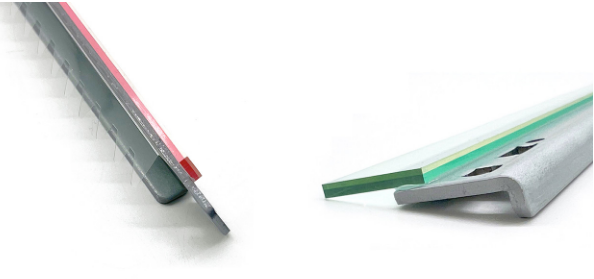
As copiers and printers moved past 40 PPM, with finer chemical toner and higher drum speeds, the single-layer blade design hit a wall. A single layer of polyurethane can be made highly resilient, or it can be made long-lasting — but forcing both properties into one sheet means trading one away to get the other.
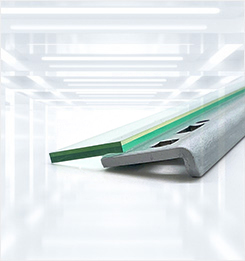
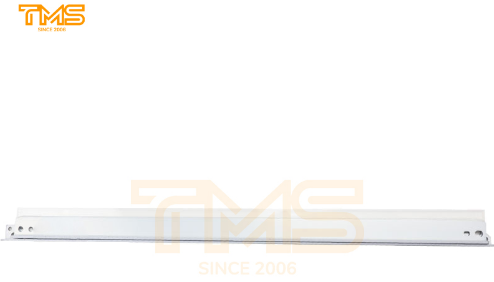
The multi-layer construction resolves that conflict by separating the functions: a resilient layer holds the edge in contact and absorbs load, bonded to a structure that resists fatigue across the full service interval. TMS developed this multi-layer blade technology and holds a patent on it, producing it specifically for the mid-to-high-speed machines where single-layer blades give out early. The same construction also carries a low-friction surface treatment on higher-end variants, which lowers drag and heat at the edge — two of the main drivers of premature hardening.
Recommended TMS Drum Cleaning Blades
TMS builds cleaning blades as a product line in their own right, matched to specific machine groups rather than sold on a "close enough" basis. Four widely requested units:
1、Toshiba e-STUDIO 5520C Double-Layer Drum Cleaning Blade — TMS2171G-TH
Fits the e-STUDIO 5520C, 6520C, 6530C, 5540C, 6540C and 6550C colour machines — high-speed, high-volume platforms where fine toner and high drum speed are exactly the conditions the multi-layer construction was developed for.
2、Xerox WorkCentre 7425 Double-Layer Drum Cleaning Blade — TMS2090G-TH
Covers WorkCentre 7425, 7428 and 7435, plus the ApeosPort-III C2200 and C3300. One part number across a widely installed Xerox colour fleet.
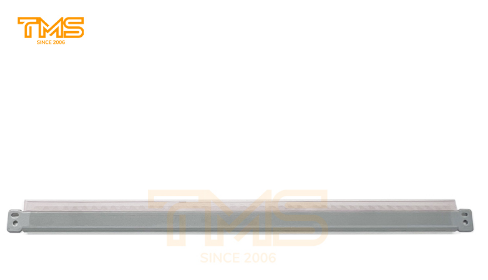
3、Ricoh MP C3003 Series Drum Cleaning Blade — TMS2177G
Covers MP C3003, C3503, C4503, C5503 and C6003, the C3004–C6004 follow-on series, and the IM C3000–IM C6000 platform. The highest-volume Ricoh blade in the TMS range, with a single part number spanning an entire colour fleet.
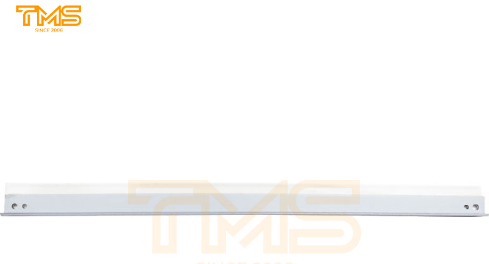
4、Ricoh MPC 2003 Series Drum Cleaning Blade — TMS2064G
Fits MP C2003, C2503, C2004, C2504, C2011SP, the IM C2000 / IM C2500 and the M C2000 / M C2001 / M C2501 compact colour class — the machines most often found in small and mid-size offices.
Where These Parts Come From
Most suppliers treat the cleaning blade as an accessory to the cartridge business — something listed because buyers ask, not something engineered. TMS treats it as a product line in its own right, with dedicated tooling and its own polymer formulation, and produces more than six million blades a month.
That depth is why the range covers both ends of a fleet: current high-speed machines that need the multi-layer construction, and legacy models most suppliers have quietly stopped carrying. Coverage runs across Ricoh, Canon, Xerox, Kyocera, Konica Minolta, Sharp, Toshiba, HP, Brother, Lexmark and Samsung platforms, alongside charge rollers, fuser film sleeves, transfer belts and feed components.
The buyers are mostly the people who meet the blade at the machine — service companies, independent dealers and managed print providers — and they judge it on one thing: whether the same part number behaves the same way in the next batch. Nearly two decades of that judgement, across customers on every continent and machines running in freezing warehouses, hot print rooms and humid coastal offices, is what keeps orders coming back. A blade whose hardness sits slightly off-spec fails fast in any of those conditions — which is precisely why consistency and cross-model compatibility are the two words buyers reach for when explaining why they reorder.


